The printout in the nightstand drawer

My bag landed on the stool in the hall at twenty past nine, and he came out to meet me in an apron.
Under the apron was the cage. Back then, five years ago, he wore it on his own account: bought it himself, locked it himself, kept the key on his own keyring and waited every evening for me to want to take it. I didn’t take it. I took off my shoes, ate what he had cooked, and tried not to notice the way he watched me. The key rang against the car keys every time he left the house, and I heard that ring as a question.
Dinner was on the stove. He heated it, put a plate in front of me, then got down on the floor by my chair and took my foot in his hands. That was his idea too, a couple of months before that evening, and I didn’t object: after twelve hours in heels your feet hum. He worked my heel with his thumbs and kept quiet exactly long enough for me to relax.
“I’ve been thinking,” he said into my foot. “You could decide things sometimes. Not only when I ask. So I’d know it’s you deciding.”
“Not tonight.”
“I’m not asking for right now. Just think about it.”
“That’s the third time this month.”
He went quiet. His hands on my foot didn’t stop, but they changed: he was stroking, not working, and waiting for an answer. I finished eating, took my foot back and went to the bedroom. Whatever he said after me I didn’t catch and didn’t ask him to repeat.
The sheet of paper
He came in ten minutes later. In his hand was a sheet of paper, printed, folded in half, and from the way he held it, two fingers on one corner, I could tell he had been carrying it in his pocket for days.
“This isn’t to push you. Just read it whenever you want.”
I took the sheet. Didn’t unfold it. Opened the drawer of the nightstand, put it in and shut it. He looked at the drawer the way people look after a train that has left. I could guess what was on it: numbered points, who does what in the evenings. He is good at lists. I had no intention of reading it that night.
I sat on the bed, he stood in the doorway, and I had to say something, because staying silent any longer would have been the same pressure, only from my side. I didn’t know whether I wanted what he was asking for. I knew what I didn’t want: to be asked about it on Thursday, on Saturday and again next Tuesday, every time at the hour when I can barely stand up.
“Key.”
He didn’t understand.
“The key to the cage. Give it here.”
He pulled out his keyring and took a long time working the small key off the ring; his fingers wouldn’t cooperate. He put it in my palm. Warm from his pocket. I opened the same drawer, laid the key on top of the sheet and shut it again.
“You keep asking me to decide. Fine. First decision: you don’t bring this up again. Not tomorrow, not next week. If I want to, I’ll say so myself. If I don’t, I won’t. Second: the key lives here. Third: I haven’t had dessert. Bring it.”
He stood there. I watched his face change: hurt first, then something like fright, then relief, though it took me a moment to find that word. He had got not what he asked for, and exactly what he asked for. He nodded and went to the kitchen.
Night
He brought a yoghurt and a spoon on a saucer and didn’t sit on the bed. He sat on the floor with his back to the nightstand, to that very drawer, and put his hands on his knees. I ate and looked down at him. Before, in moments like that, he waited: his eyes followed my face, checking whether I was ready to talk. Now he was looking at the floor, and for the first time in a month I ate in my own bedroom without feeling that a question was coming.
It was quiet. I listened to that quiet the way you listen to a flat after the fridge has been switched off: it turns out it had been humming the whole time.
“Lie down,” I said. “On the edge.”
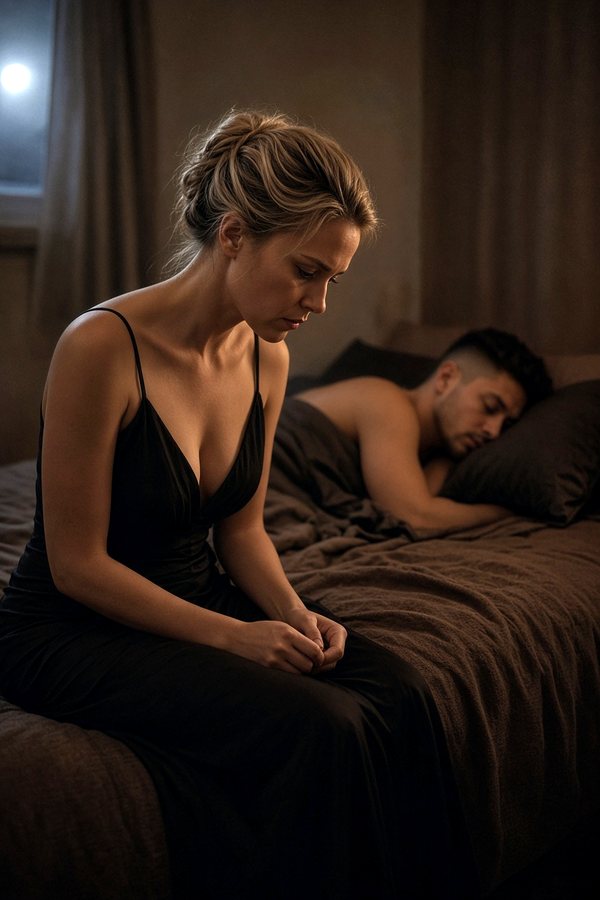
Usually he lay close and waited: would I touch him or not, say something or not. That night he lay on the edge, on his back, arms on top of the duvet, and fell asleep before me. I listened to him breathing, and once, in the dark, I put my hand on his stomach over the duvet, where the lock was under the fabric. He didn’t wake. I lay there thinking about the key in the drawer. It had been there for two hours, and in two hours nobody had asked me about it. I liked that. More than I had expected to.
Morning
The coffee was on the table with a note beside it: “Dry cleaning — I’ll collect it at lunch. Dinner at eight.” No question, no “how are you”. I read it twice to make sure there was nothing between the lines. There wasn’t. The coffee was stronger than I make it for myself. That is how he makes it when he wants me to notice and says nothing.
I took his pen and wrote under his line: “Cage on until evening. Feet tonight, half an hour.” I thought, and added: “Key stays where it is.” He couldn’t have touched it anyway. But I wanted to write it in my own hand.
In the lift I caught myself smiling. Half an hour of feet is nothing, and I had set it myself; nobody had walked me to it with a printout. While he was asking, any “yes” from me would have been his win, and I could feel that on my skin, which is why I kept saying “not tonight”. That morning the “yes” was mine. It turned out to be the first one.
That evening he did my feet for half an hour by the timer. The timer stood on the armrest, and he never once looked to see how much was left, and never said a word about us. I did. One thing: “Same tomorrow.” He said “yes”, and from his voice I could tell he was holding himself back from saying more.
I read the sheet from the drawer a month later. Crossed out half the points, kept three, added one in my own hand. The key still lives in that drawer, and it is there now, as I write this.
- If he asks a third time in a month, answer once and differently: “stop asking” instead of “not now”.
- Take the key that same evening, even if you have no plans to use it. A key in your drawer changes the conversation.
- Set the first rule yourself, small and useful to you: half an hour of feet, cage on until evening.
- Don’t read his printout straight away. Read it once you have your own.
- Count your decisions, not his requests. When the first outnumber the second, the wanting comes on its own.
— Vera
Topics: Femdom in an ordinary marriage · Male chastity · FLR
Why He Wants a Female Led Relationship and What You Gain
In a female led relationship he finds relief from constant decisions while you receive the center stage you deserve.
Chapter 1 of 44 in the book for her · the beginning of every chapter is open
More stories

The timer clicked and he stood at the wall
My husband asked for the third time to be punished over the floor. An old kitchen timer, ten minutes at the wall and one rule: how I learned he wasn’t asking…
Under the stove too
My voice came out quieter than I meant, and something clenched: the guilt of being strict when he asked for it.

The lock clicked and I didn’t even take off my coat
The evening I said “do not disturb”: he didn’t kneel, didn’t take my shoes off, put down a cup of tea and left.